MetaOthello: A Controlled Study of Multiple World Models in Transformers
1Vermont Complex Systems Institute, University of Vermont · 2University of Michigan
*Equal contribution
ICML 2026 · Seoul, South Korea
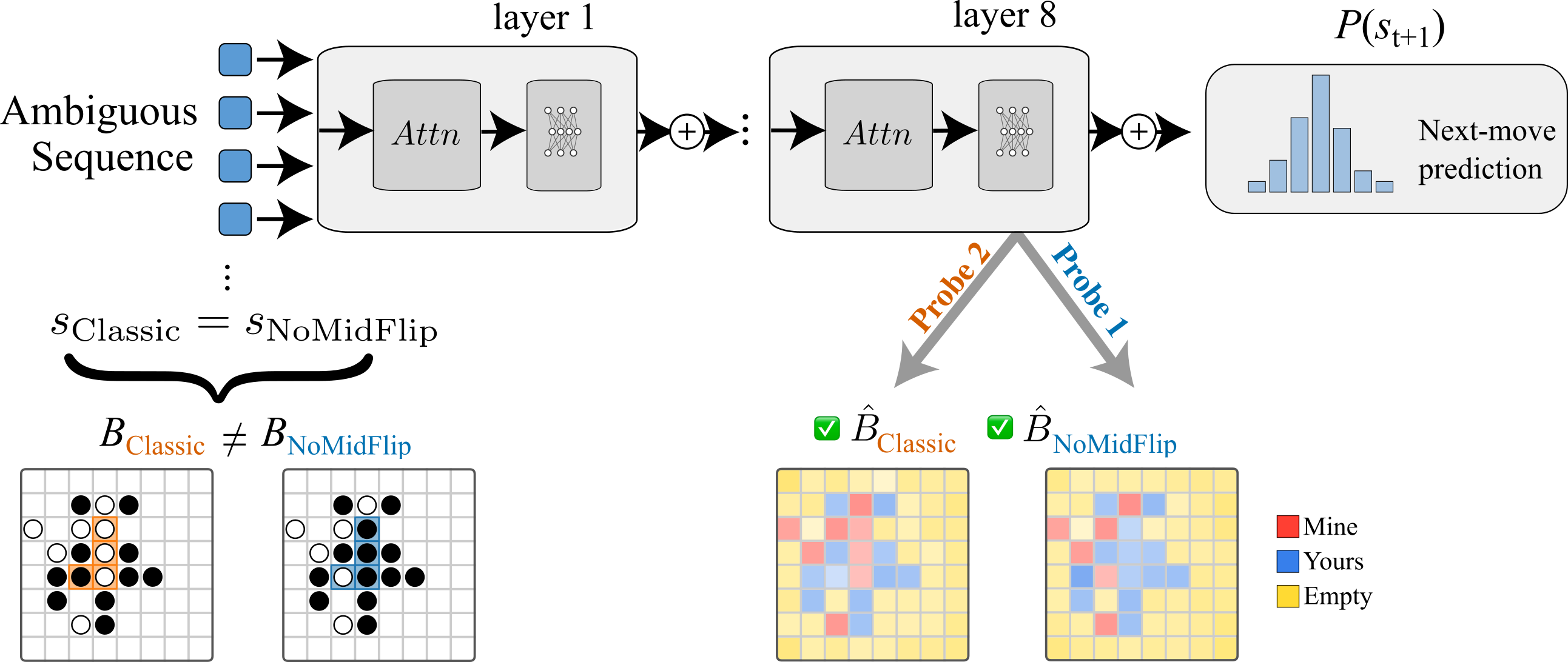
MetaOthello is a suite of Othello-like games played on the same 8×8 board, but follow different rules. We train small GPTs on sequences from mixtures of these games. We then probe the model to read — and intervene on — the board state it believes it is tracking. We show how the model learns to abstract across disparate games and, importantly, how it resolves ambiguity.
We Find
Shared Representations
Transformers learn to generalize shared abstractions. Board represenations for two disparate games is causally interchangeable.
Shared Computation
Models perform game-general computations in early layers and then later identify game identity for game specific calculations.
Ambiguity Circuit
When game sequences overlap and board representations are causally shared, we show mechanisms of how model resolve ambiguity.
Cite Us
If you find MetaOthello useful, please cite our paper:
@inproceedings{chawla_hall_2026_metaothello,
  title     = {MetaOthello: A Controlled Study of Multiple World Models in Transformers},
  author    = {Chawla, Aviral and Hall, Galen and Lovato, Juniper},
  booktitle = {Proceedings of the 43rd International Conference on Machine Learning},
  series    = {Proceedings of Machine Learning Research},
  volume    = {306},
  year      = {2026},
  address   = {Seoul, South Korea},
  publisher = {PMLR}
}